

The AI Infrastructure Cycle Got an Investment-Grade Rating - The Binding Constraint is the Layer No One is Pricing
What the Term Loan Covenants Reveal that the Equity Tapes Miss - And Why the Financed Claim Cannot Outperform the Unlevered Physical Inputs.

The cycle is a financing-architecture story — not a demand story, not a technology story
The dominant misread of the AI infrastructure cycle is that it is a demand story or a technology story. It is neither. Demand is structurally unmet and will remain so; technology leadership is contested but irrelevant to the binding constraint. The cycle is a financing-architecture story, and it has now entered its decisive phase: between 2023 and March 2026, GPU-backed credit compressed from ~15% high-yield equipment financing to sub-6% investment-grade institutional debt — one of the fastest cost-of-capital re-ratings in the history of infrastructure finance. That compression pulled hundreds of billions of institutional capital into the financed layers of the stack. But the same capital cannot manufacture a gas turbine in under three years, cannot adjudicate a senior water right, cannot relocate stranded Permian gas, and cannot conjure controlled, permitted, transmission-adjacent land. The capital is abundant and getting cheaper at the top of the stack; the physical inputs are fixed and getting scarcer at the bottom. The durable value is migrating down the stack, away from the financed claim and toward the unlevered physical input. Everything below develops, prices, and stress-tests that claim.
The conclusions
1. The asset class was created by moving the credit from the hardware to the offtaker, and that is exactly where it will be tested. DDTL 4.0’s “material contract adverse event” default and deferred DSCR testing are not technicalities; they are the precise location of the cycle’s fragility. The first significant covenant test — structurally, the DDTL 4.0 DSCR in mid-2027, with predecessor equity-cure windows expiring late 2026 — is the event to underwrite against, not any equity-multiple move.
2. The cost-of-capital compression was the bull case and is now the bear case. The same reclassification that pulled mandated, rating-sensitive institutional capital into the stack is the reason the May 2026 long-end move is so consequential: the marginal holder entered on the rating, not the fundamentals, and the rating’s durability is hostage to a single offtaker contract and a curve that just broke to a 2007 high.
3. Twenty-year take-or-pay PPAs are the market confessing the thesis in its own paper. No rational hyperscaler signs a two-decade obligation for an input it believes will be abundant. The tenor is the proof that physical capacity is the scarce, durable asset.
4. Nvidia’s $3.5B land/power/shell guarantee line is the single highest-information forward disclosure in the complex. If it rises, the most central vendor in the cycle is using its balance sheet to take the same side this report takes — the physical layer.
5. There is no rate path on which the financed claim outperforms the unlevered physical input from here. Higher-for-longer punishes the levered claim directly; financial repression debases it through inflation. The physical input is long under both. This is the report’s terminal conclusion and the strategic orientation it recommends: own the recovery floor, not the claim on it.
6. The convergence is the asset, not any single input. Land, gas, water, and turbine procurement traction co-locating in a single low-opposition Far West Texas jurisdiction is not four separate theses; it is one structural position whose value widens every time the financed layer above it reprices.
Every instrument in the stack is ultimately a claim on the physical input beneath it
The AI infrastructure capital stack is not a metaphor. It is five layers of capital with materially different rights, costs, and recovery profiles. The analytically useful unit is not the company — it is the financing instrument, because the instrument’s terms reveal who actually bears the risk.
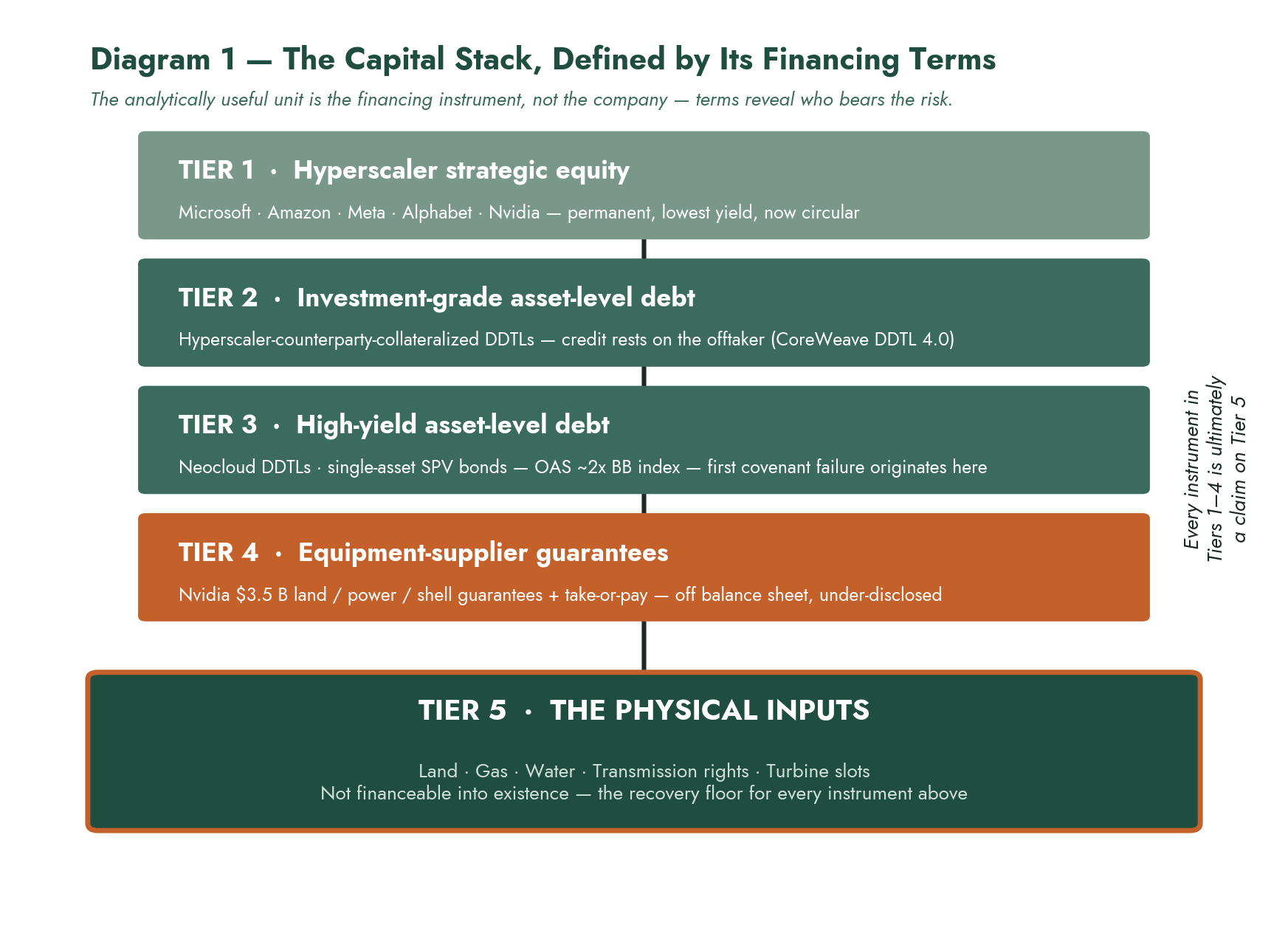
Tier 1 — Hyperscaler strategic equity. Microsoft, Amazon, Meta, Alphabet, and Nvidia deploying balance-sheet equity into neoclouds, chip vendors, and infrastructure JVs. Lowest yield, highest position in the stack, effectively permanent capital. The defining 2026 development is that this tier has become circular — the chip vendor invests in the customer that buys the chips (developed in §V).
Tier 2 — Investment-grade asset-level debt. Hyperscaler-counterparty-collateralized facilities that achieve an institutional rating because the credit rests on the offtaker, not the operator. The CoreWeave DDTL 4.0 (full terms in §IV) is the archetype and the single most important financing event of the cycle.
Tier 3 — High-yield asset-level debt. Neocloud delayed-draw term loans and single-asset SPV bonds priced at option-adjusted spreads roughly twice the BB high-yield index at issuance. This is the tier most exposed to the cost-of-capital regime change and the tier where the first covenant failure will originate.
Tier 4 — Equipment-supplier guarantees and vendor backstops. Nvidia’s disclosed $3.5 billion in land/power/shell guarantees plus take-or-pay arrangements that do not appear as debt on any balance sheet but function as credit support. The most under-disclosed tier; the one that quantifies how much the chip vendor is underwriting its own demand.
Tier 5 — The physical inputs. Land, gas, water, transmission rights, turbine slots. Not financeable into existence on any timeline that matters. The recovery floor for every instrument in Tiers 2–4. The thesis is that Tier 5 is mispriced because the market values it as a commodity input rather than as the binding constraint and the recovery asset simultaneously.
The market analyzes this stack top-down — it asks “is the equity cheap, is the credit money-good.” The correct analysis is bottom-up: every instrument in Tiers 1–4 is ultimately a claim on Tier 5. When the financed layers reprice (as they did materially in May 2026), the claims compress while the underlying physical asset does not move. That divergence is the trade.
In under three years, the same borrower repriced from ~15% private credit to sub-6% investment-grade debt
The single most important fact in AI infrastructure finance is the speed of the credit re-rating, because cost of capital compounds directly into deployment speed, and deployment speed captures contracts, and contracts support larger facilities at tighter spreads. The moat is self-reinforcing — for whoever is inside it.
The CoreWeave DDTL progression is the cleanest available record of the compression:
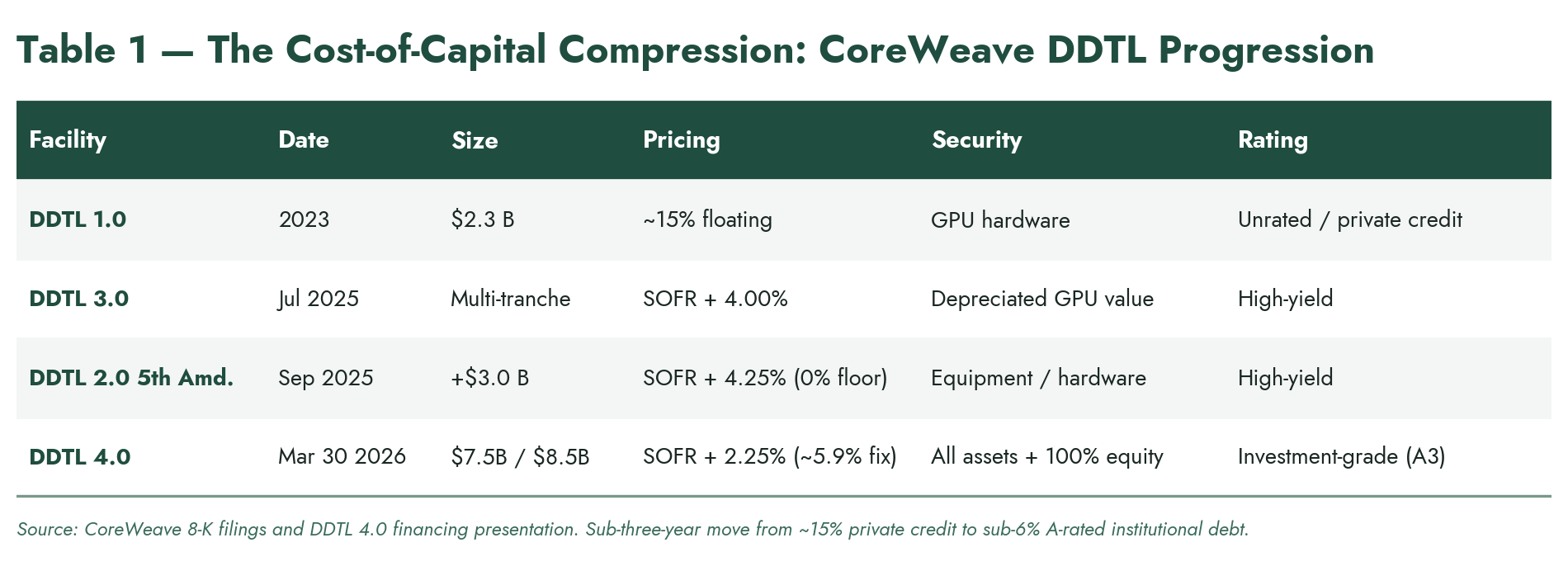
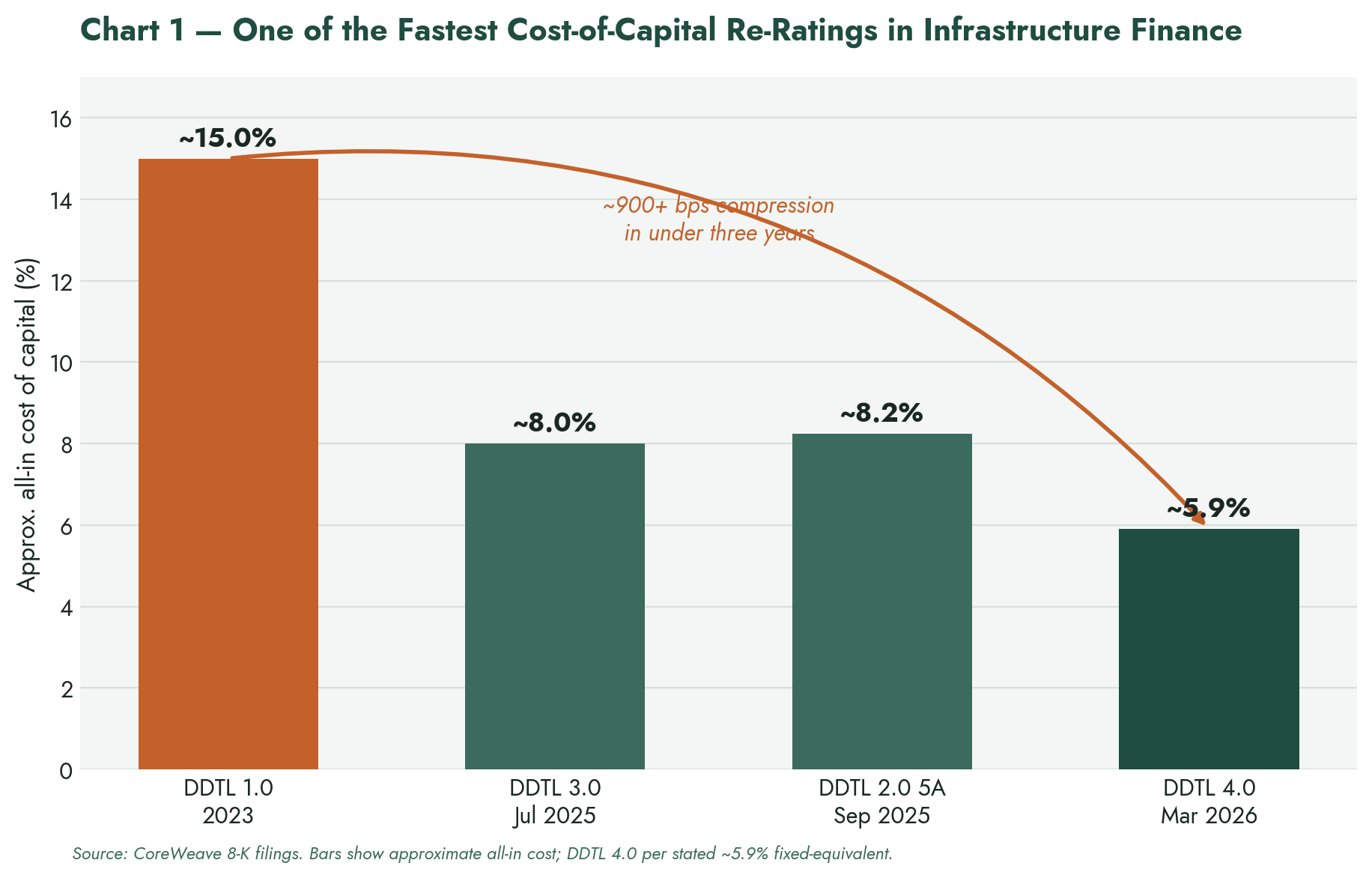
In under three years, the same borrower moved from ~15% private-credit equipment financing to sub-6% A-rated institutional infrastructure debt. That is not negotiation. It is a reclassification of the asset by the lending market. The rating is the event; the size is secondary. Before March 31, 2026, AI infrastructure debt was the domain of private credit and tactical funds demanding 10–15% risk premiums for two genuine concerns: GPUs depreciate faster than traditional infrastructure, and AI demand durability was unproven. Investment-grade status unlocks a structurally different and vastly larger capital pool — pension funds, insurers, sovereign wealth — that is mandated into long-duration, A-rated paper.
The conventional read is that IG status de-risks the asset class. The structural read is the opposite: the compression pulled in capital that is mandated and price-insensitive at the rating, which means the marginal lender no longer underwrites the GPU depreciation curve or the demand-durability question — it underwrites the rating and the offtaker. That works precisely until the offtaker’s credit, the rate environment, or the contract-realization assumption is tested. The faster the compression, the larger the pool of capital that entered on the rating rather than on the fundamentals, and the more violent the repricing when the fundamentals are tested. The May 2026 long-end move (§VIII) is the first test.
The CoreWeave DDTL 4.0 encodes exactly where the cycle’s fragility sits
This facility is treated at length because it is the template the entire institutional AI-credit market is now copying, and because its terms encode exactly where the risk has been placed.
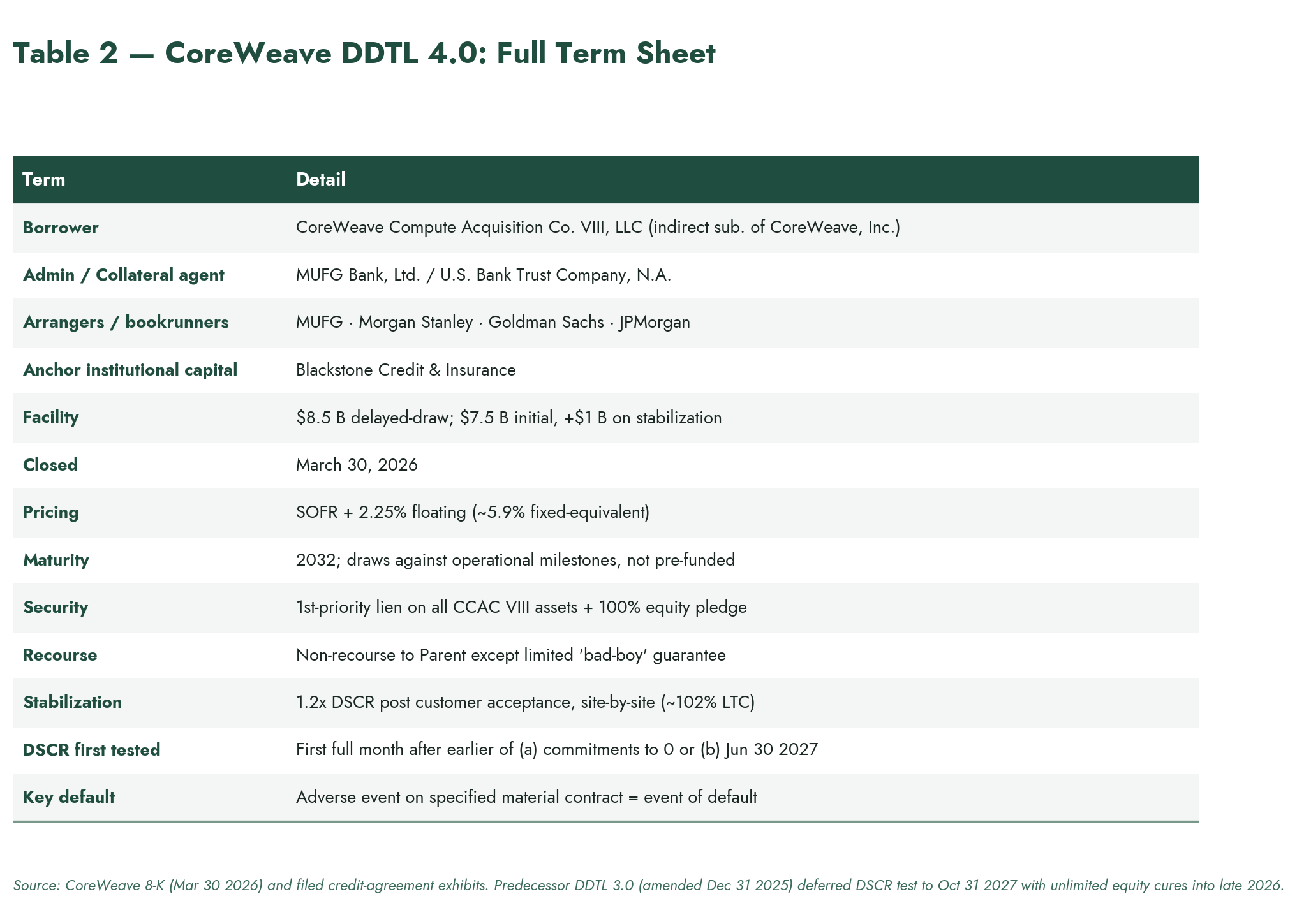
Parties. Borrower: CoreWeave Compute Acquisition Co. VIII, LLC (”CCAC VIII”), a Delaware LLC, indirect subsidiary of CoreWeave, Inc. (the “Parent”). Administrative agent: MUFG Bank, Ltd. Collateral agent: U.S. Bank Trust Company, N.A. Depository: U.S. Bank N.A. Coordinating lead arrangers and joint bookrunners: MUFG and Morgan Stanley Asset Funding. Additional arrangers in the syndicate: Goldman Sachs, JPMorgan. Anchor institutional capital: Blackstone Credit & Insurance.
Facility. $8.5 billion delayed-draw term loan; $7.5 billion initial capacity, expandable by ~$1 billion upon stabilization. Closed March 30, 2026. Stated purpose: finance capital expenditures to perform a specific customer contract — GPU servers and related infrastructure — understood to be Meta-anchored (estimated ~$19 billion contracted backlog attributable).
Pricing. SOFR + 2.25% floating; ~5.9% fixed-equivalent. For context this is ~175 bps inside DDTL 3.0 (SOFR + 4.00%) and roughly 900+ bps inside DDTL 1.0.
Maturity. Facility maturity 2032. Delayed-draw structure: capacity drawn against operational milestones, not pre-funded.
Security. First-priority lien on substantially all assets of CCAC VIII and its subsidiaries — cloud infrastructure equipment and all tangible/intangible assets — plus a pledge of 100% of the equity interests in CCAC VIII held by CCAC VIII Holdco LLC.
Recourse. Non-recourse to the Parent except a limited “bad-boy” guarantee covering GPU installation and related performance obligations. Subsidiary guarantees are unconditional via the collateral agreement.
The structural innovation — execution-linked borrowing. DDTL 4.0 breaks from the asset-based model. Earlier facilities capped borrowing at depreciated GPU value. DDTL 4.0 ties draw capacity to operational deployment milestones and a stabilization framework: a 1.2x debt-service-coverage ratio post-acceptance by the underlying customer, on a site-by-site basis, implying up to ~102% loan-to-cost. Borrowing scales as assets reach stabilization, removing pre-funding drag and aligning lender and borrower incentives. Power availability and power-cost volatility are explicitly addressed in the funding conditions — the first major facility to embed energy access in the covenant structure itself.
Financial covenants. Debt Service Coverage Ratio, first tested the first full calendar month after the earlier of (a) the date commitments reduce to zero or (b) June 30, 2027. (Note: the prior DDTL 3.0 covenant suite, amended December 31, 2025, postponed initial DSCR testing to October 31, 2027 and the contract-realization ratio test to February 28, 2026, and permitted unlimited equity cures before October 28, 2026, then up to three consecutive months in any four-month window thereafter — a meaningful tell about expected covenant pressure.) Customary negative covenants, cross-default to other indebtedness, change-of-control default, bankruptcy events, and — critically — events of default tied to adverse events on specified material contracts.
Three terms carry the entire risk story. (1) The DSCR is not tested until mid-2027 and the predecessor facility allowed unlimited equity cures into late 2026 — the structure is explicitly built to defer the first real coverage test past the current deployment ramp. (2) The “material contract adverse event” default converts this from a GPU loan into a single-counterparty credit instrument: if the anchor offtaker’s contract is impaired, the facility defaults regardless of asset value. (3) The ~102% loan-to-cost at 1.2x DSCR means there is almost no equity cushion beneath the debt at the project level — the recovery case rests entirely on (a) the offtaker continuing to pay and (b) the residual value of depreciating GPUs plus the underlying physical site. The lender has, in effect, underwritten the offtaker’s multi-decade credit and the physical recovery asset. The GPU is the wasting asset in the middle; the site is the floor. This is project finance wearing an investment-grade rating, and the rating is only as durable as the single material contract and the rate environment in which it must eventually refinance.
The takeaway: DDTL 4.0 is the proof of the financialization thesis and the encoded location of its fragility. The asset class was created by moving the credit from the hardware to the offtaker. That makes the instrument money-good while the offtaker is money-good and the curve is stable, and structurally exposed the moment either is tested. The recovery floor is the physical site — which is the entire point of the report.
Primary source: CoreWeave 8-K, March 30, 2026 (SEC EDGAR) · CoreWeave DDTL 4.0 financing overview
Nvidia’s $100B instrument is vendor financing reclassified as strategic equity
The Nvidia–OpenAI arrangement is the most important Tier 1 instrument in the cycle, and the structure — not the headline number — is the analytically relevant content.
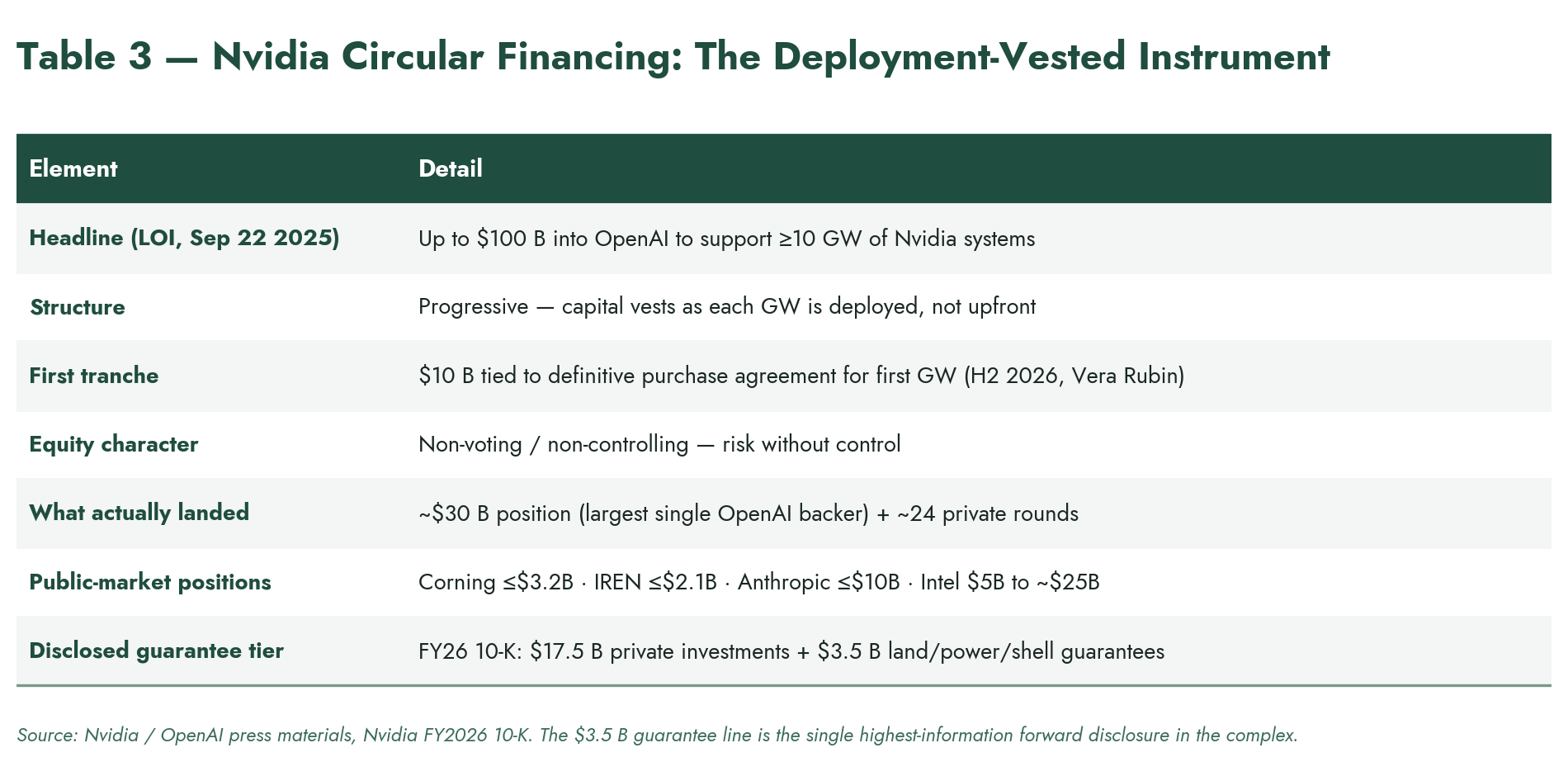
Headline. Letter of intent, September 22, 2025: Nvidia intends to invest up to $100 billion in OpenAI to support deployment of at least 10 GW of Nvidia systems.
Structure — progressive, deployment-vested. Capital is committed progressively as each gigawatt is deployed, not upfront. An initial $10 billion tranche is tied to execution of a definitive purchase agreement for the first gigawatt. First gigawatt targeted H2 2026 on the Vera Rubin platform. The equity Nvidia acquires is explicitly non-voting / non-controlling.
Evolution — the structure did not survive contact with reality. The original up-to-$100B framework was not consummated as drafted. OpenAI pivoted to a partner-led infrastructure strategy (Oracle, Microsoft, Amazon); a ~$30 billion Nvidia position is what actually landed as OpenAI’s single largest equity backer, alongside ~24 private placements plus public-market positions (up to $3.2B Corning, up to $2.1B IREN, up to $10B Anthropic component, $5B Intel now marked ~$25B).
The disclosed guarantee tier. Nvidia’s fiscal 2026 10-K discloses $17.5 billion in private-company/infrastructure-fund investments plus $3.5 billion in land, power, and shell guarantees to early-stage companies — a distinct, under-analyzed line.
Tying the investment to each deployed gigawatt is presented as alignment. Structurally it is a circular-revenue mechanism: Nvidia funds the customer’s ability to buy Nvidia hardware, recognizes the hardware revenue, and holds a non-voting equity claim whose value depends on the same deployment it just financed. In a rising market this compounds beautifully. In a stressed market the exposure is doubled — GPU rental compression impairs the equity stake and the customer’s ability to take the next tranche of chips, while the $3.5B of land/power/shell guarantees crystallize precisely when the physical layer is tightest. The non-voting feature is not a concession; it is risk without control, which is the worst quadrant if the cycle turns. The single most important forward disclosure in the entire complex is whether that $3.5B guarantee line rises in the next 10-Q. If it does, the vendor most central to the cycle is using its balance sheet to vote that the physical layer — not the financed layer — is where it must secure its position. That is the same conclusion this report reaches from the opposite direction.
Primary source: OpenAI–NVIDIA strategic partnership announcement · NVIDIA Newsroom · NVIDIA fiscal 2026 Form 10-K (SEC EDGAR)
The twenty-year take-or-pay PPA is the demand side confessing the physical-scarcity thesis in its own paper
The financing terms above are only underwritable because of the offtake terms beneath them. The dedicated-generation market has settled, structurally, on twenty-year-plus take-or-pay power purchase agreements at gigawatt scale with investment-grade-equivalent counterparty credit. Representative structures: Talen–Amazon, Susquehanna nuclear through 2042, ~1,920 MW, ~$18B estimated revenue; Constellation–Meta, 20-year, 1.1 GW; Vistra–Meta, 20-year, 2.1 GW+, plus a $4.7B Cogentrix gas acquisition explicitly to plug the PJM reliability gap.
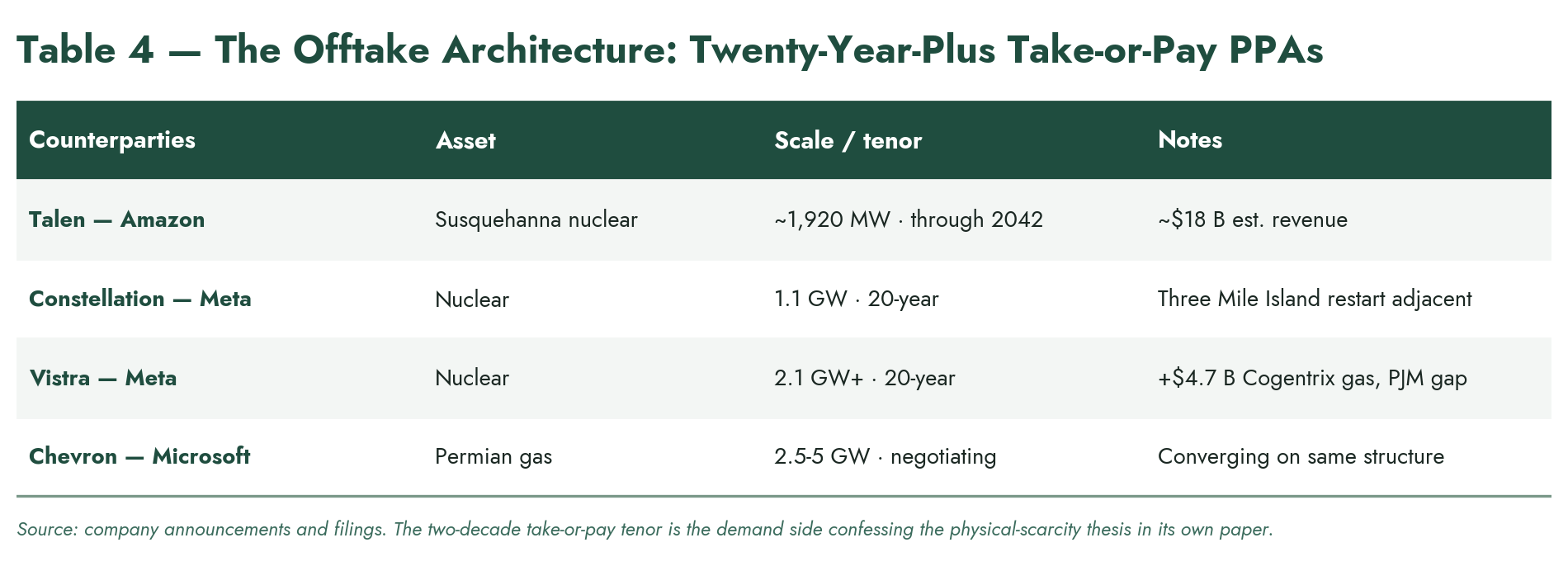
Caption: The Offtake Architecture: Twenty-Year-Plus Take-or-Pay PPAs
A hyperscaler does not sign a two-decade, take-or-pay obligation for a commodity it believes will be abundant. It signs a twenty-year contract because the physical capacity is the scarce, non-replicable input and locking it is worth more than the optionality of staying flexible. The contract tenor is the market revealing, in its own paper, that the binding constraint is physical and durable. Every twenty-year PPA signed is independent confirmation that Tier 5 — not the financing, not the chips — is the asset. The Chevron/Microsoft Permian negotiation is converging toward exactly this structure, which is why it matters far beyond a single project.
The scarce inputs do not respond to a lower cost of capital on any relevant timeline
Capital is the abundant input. The following are the scarce ones, and none responds to a lower cost of capital on a relevant timeline.
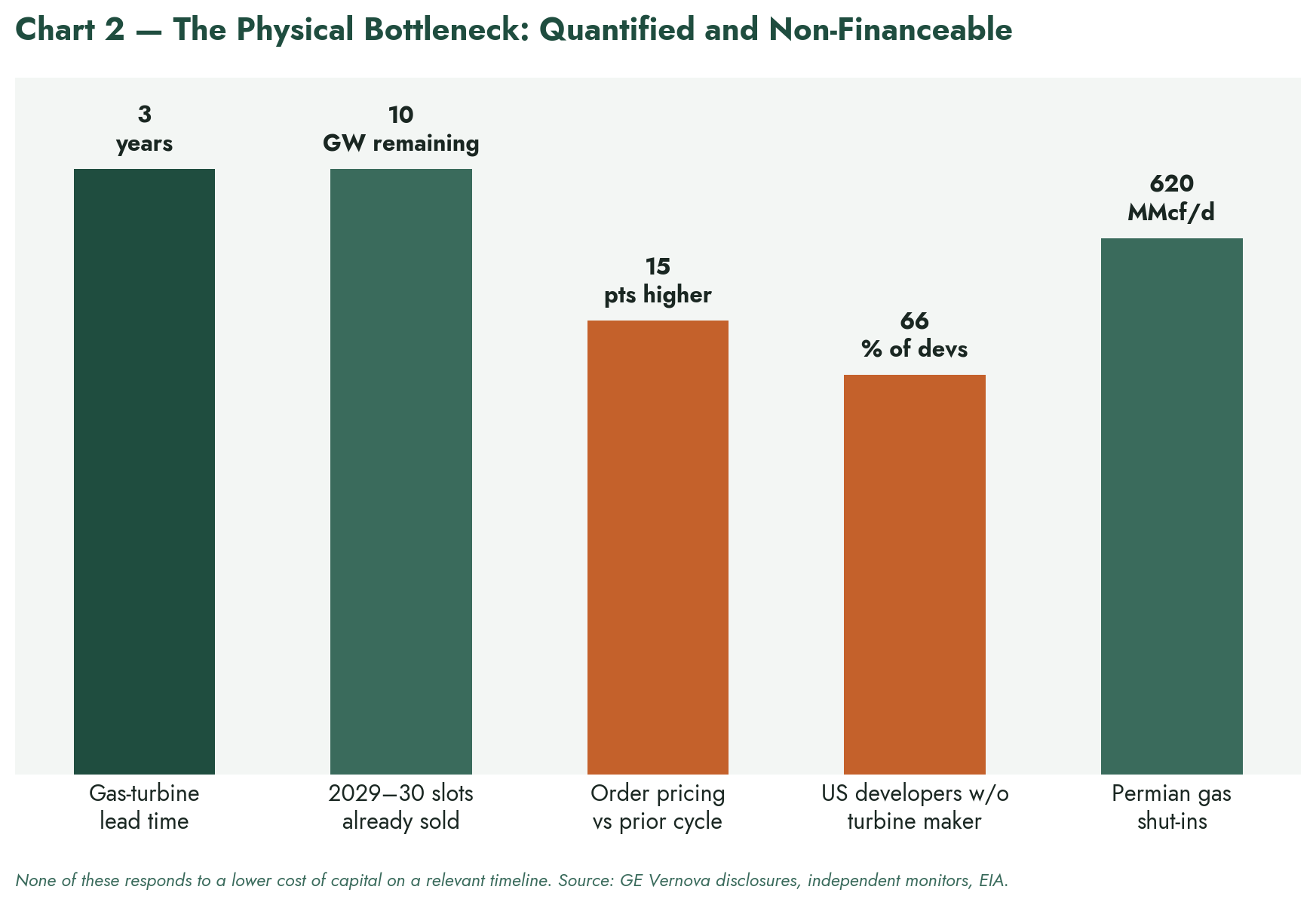
Turbines. Per GE Vernova’s most recent disclosures, gas-turbine lead times run “directionally three years,” with roughly 10 GW of remaining 2029–2030 slot capacity already being sold and order pricing 10–20 points above the prior cycle. Gas-turbine backlog plus slot reservations ~56 GW. Independent monitors estimate two-thirds of US gas-project developers have not yet identified a turbine manufacturer. A turbine slot is a hard physical option with a multi-year lead time and a rising strike price; it cannot be created with cheaper money.
Land and transmission rights. Texas SB6 / PUCT Docket 58481 converts site control from a commercial advantage into a regulatory prerequisite: $50,000/MW non-refundable interconnection fee, 100% contribution in aid of construction, site control demonstrated via deed/option/lease extending ≥5 years beyond contracted peak demand, 80% security forfeit on withdrawal. The rule mechanically advantages whoever already controls qualifying land.
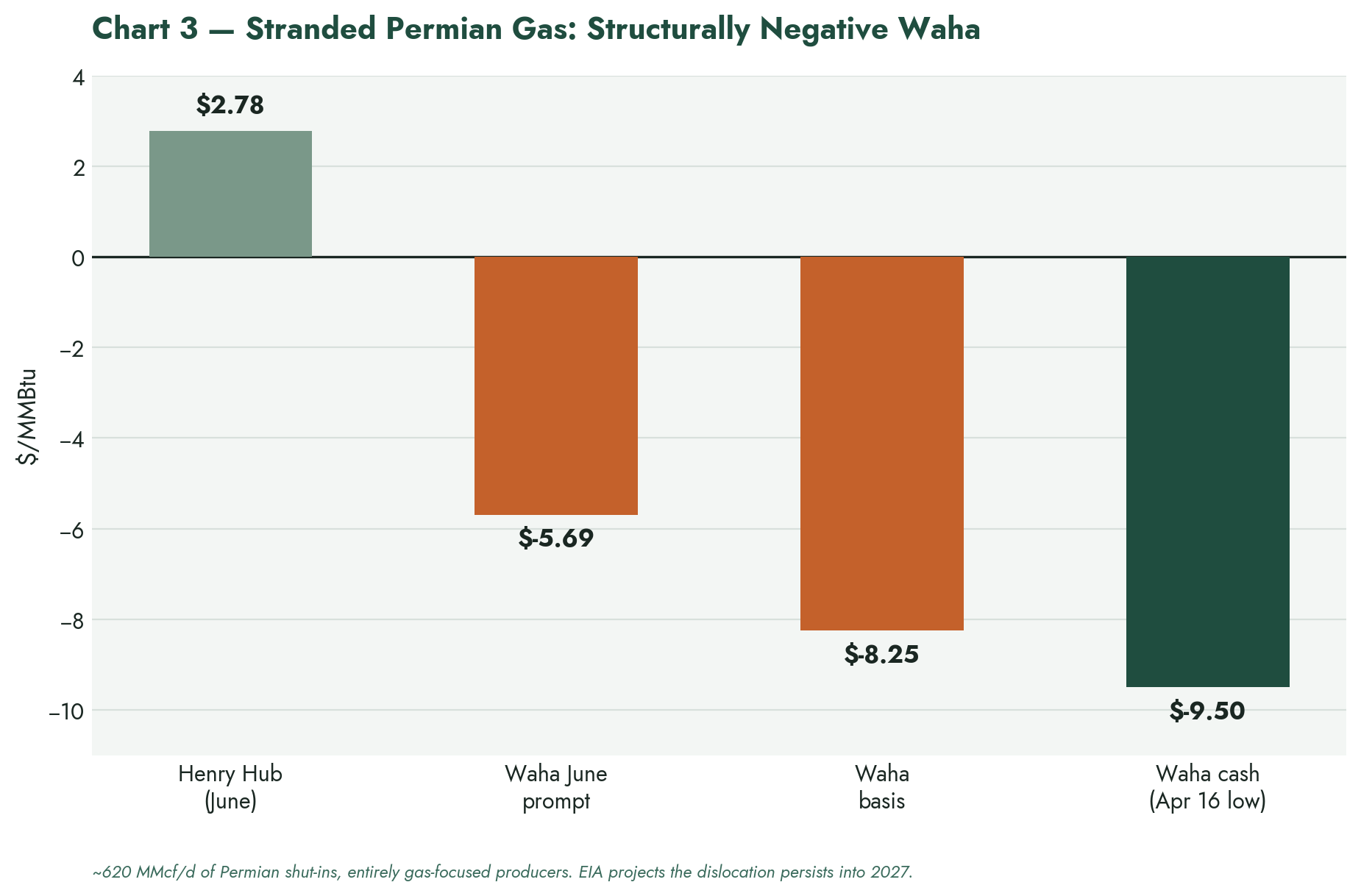
Stranded gas. Waha basis at structurally negative levels (June prompt fixed ~-$5.69/MMBtu; basis ~-$8.25; a record cash low below -$9.50), with ~620 MMcf/d of Permian shut-ins concentrated entirely among gas-focused producers. The EIA’s own outlook projects ~6% Permian gas production growth with rising gas-to-oil ratios as high crude pulls more associated gas — meaning the dislocation persists structurally into 2027 even with pipeline relief (Hugh Brinson early Q3, GCX Q2, Blackcomb Q4).
Each of these is individually scarce. The investable observation is that they co-locate in Far West Texas — Pecos and Reeves specifically — where four of the five physical inputs (land, gas, water, turbine procurement traction via the Chevron/Microsoft project; transmission is the off-grid model’s deliberate bypass) overlap in a single jurisdiction with negligible municipal opposition and large ad valorem capacity. The cost-of-capital compression of §III made the financed layers cheap; it did nothing for the physical layer. The result is a widening wedge between the price of a financed claim and the price of the underlying input the claim depends on. That wedge is the structural opportunity, and it widens — not narrows — every time the financed layer reprices.
There is no rate path on which the financed claim outperforms the unlevered physical input
The §III compression was a multi-year tailwind for the financed layer. As of mid-May 2026 it ran into a structural reversal that the financing architecture is not built for.
The 30-year US Treasury reached its highest yield since 2007; the 10-year its highest in over a year; both posted their largest weekly jumps since the early-2025 tariff shock. The driver is an energy-led, supply-shock inflation that monetary policy cannot address — a structurally-higher-inflation regime, in the framing of multiple senior practitioners now on record describing a “bond-vigilante” dynamic and a financial-repression endgame (Treasury maturity shortening, buybacks, coordinated long-end purchases) as the likely terminal state because mid-5% long yields are not fiscally sustainable.
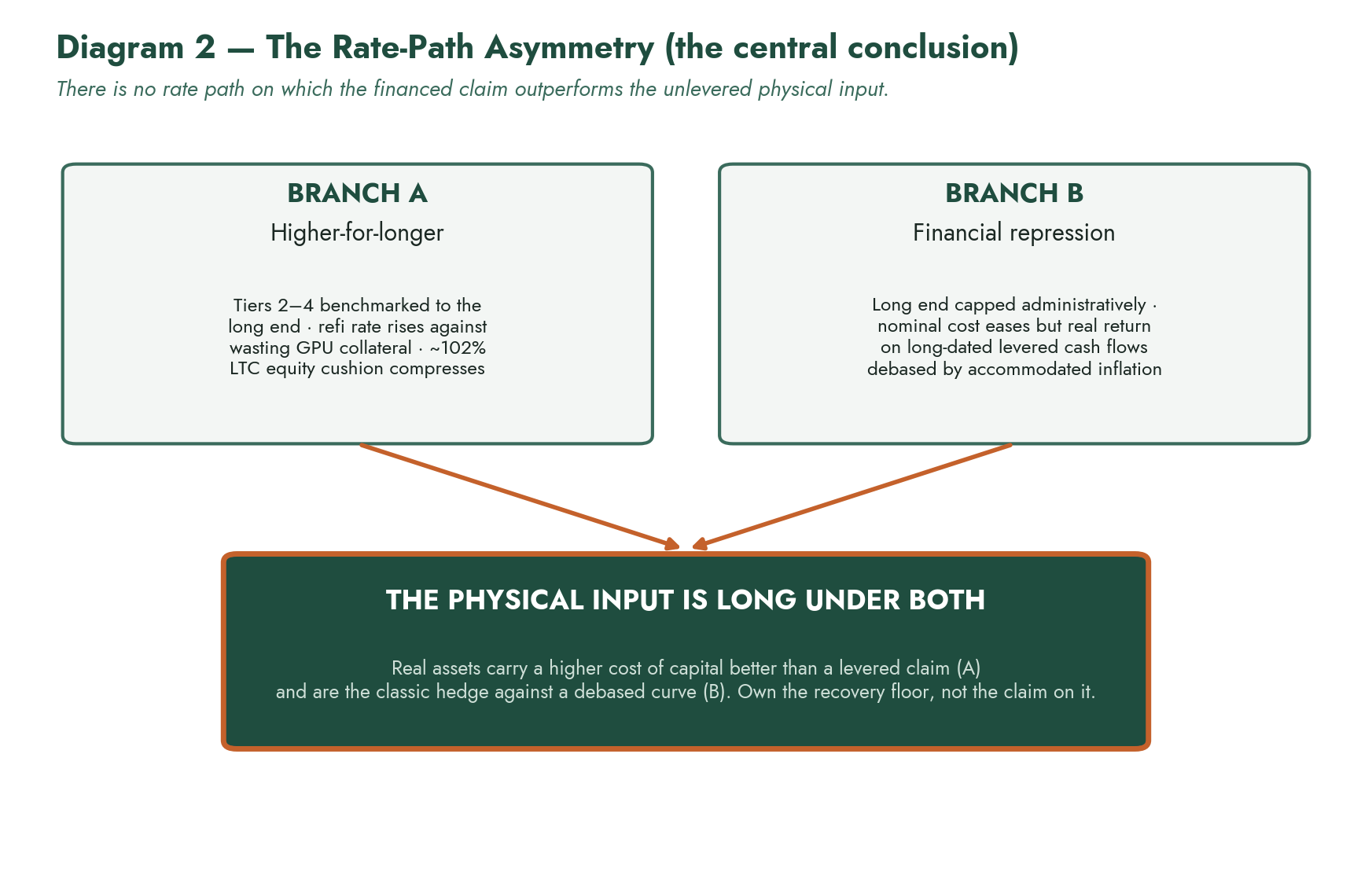
This is the central analytical conclusion of the report. Branch A — higher-for-longer: every instrument in Tiers 2–4 is benchmarked to the long end; a structurally higher curve raises the refinancing rate against wasting GPU collateral and compresses the equity beneath ~102%-loan-to-cost project structures. The DDTL 4.0 DSCR test in mid-2027 arrives into a higher-rate world than the one it was modeled in. Branch B — financial repression: if the long end is administratively capped via buybacks and central-bank purchases, nominal financing cost eases but the real return on long-dated, levered, fixed cash flows is debased by the inflation that repression accommodates. A controlled acre, an adjudicated acre-foot, and a 2029 turbine slot are real assets: they carry a higher cost of capital better than a levered claim does (Branch A) and they are the classic hedge against a debased curve (Branch B). There is no rate path on which the financed claim outperforms the physical input from here. That asymmetry is the report’s core conclusion.
The loop has no internal circuit-breaker — only the physical input is indifferent to both exits
The mechanisms above are not independent. They form a loop: an energy supply shock drives the inflation prints, the prints drive the long-end repricing, the long-end repricing reprices the entire AI financing stack, and the stress in the financing stack does nothing to relieve the energy shock that started it. The loop has no obvious internal circuit-breaker on a near-term horizon; the only exits are an exogenous resolution of the supply shock or an administrative intervention in the bond market — i.e., the financial-repression branch, which is itself bad for the financed layer.
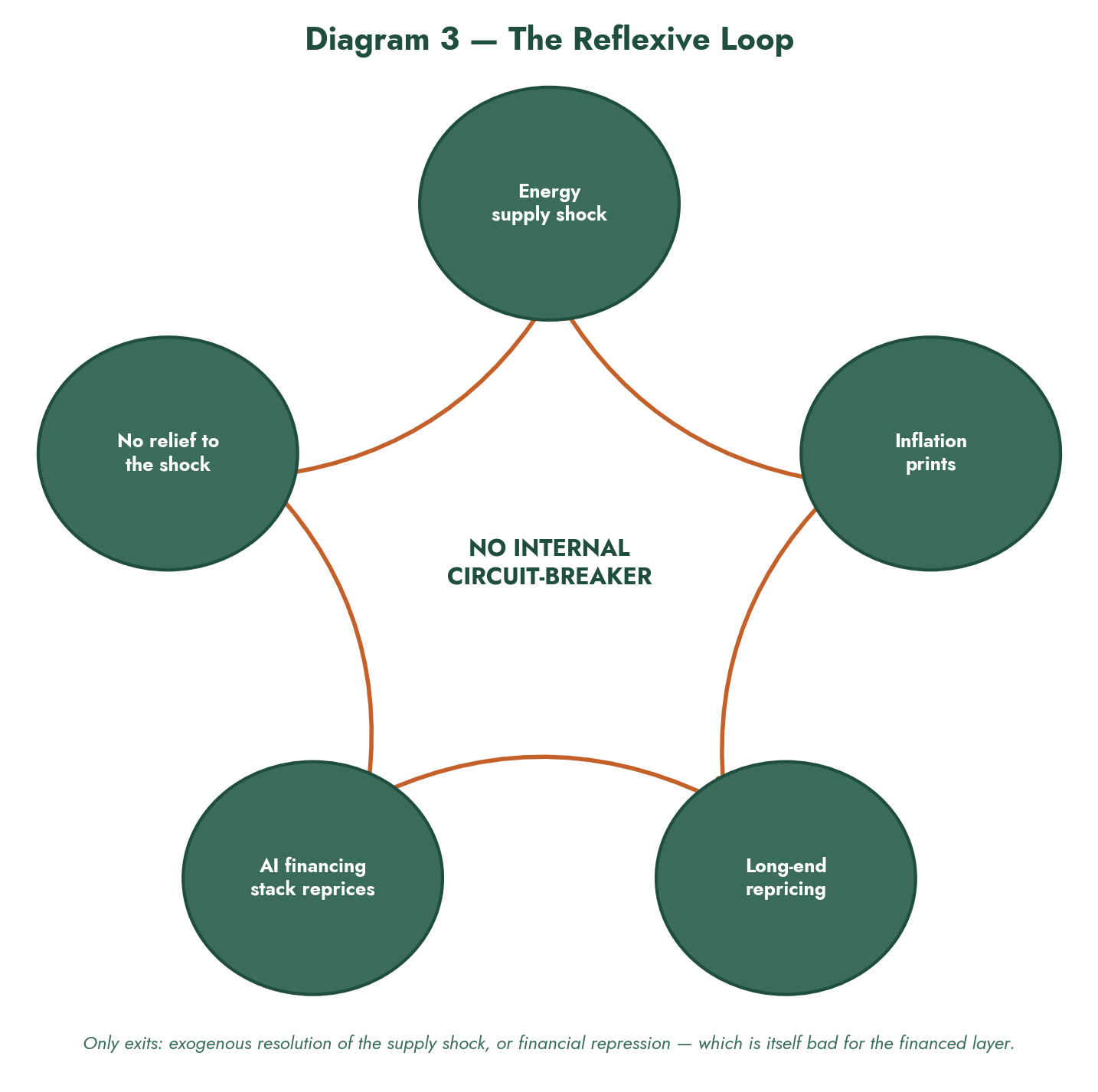
When a system’s only two exits are “the exogenous shock resolves” or “the authorities distort the price of money,” the correct position is the asset that is indifferent to both. The physical input is that asset. Every analytical road in this report — the financing-term forensics, the offtake-tenor signal, the bottleneck quantification, the rate-regime asymmetry — terminates at the same place.
The conclusions
1. The asset class was created by moving the credit from the hardware to the offtaker, and that is exactly where it will be tested. DDTL 4.0’s “material contract adverse event” default and deferred DSCR testing are not technicalities; they are the precise location of the cycle’s fragility. The first significant covenant test — structurally, the DDTL 4.0 DSCR in mid-2027, with predecessor equity-cure windows expiring late 2026 — is the event to underwrite against, not any equity-multiple move.
2. The cost-of-capital compression was the bull case and is now the bear case. The same reclassification that pulled mandated, rating-sensitive institutional capital into the stack is the reason the May 2026 long-end move is so consequential: the marginal holder entered on the rating, not the fundamentals, and the rating’s durability is hostage to a single offtaker contract and a curve that just broke to a 2007 high.
3. Twenty-year take-or-pay PPAs are the market confessing the thesis in its own paper. No rational hyperscaler signs a two-decade obligation for an input it believes will be abundant. The tenor is the proof that physical capacity is the scarce, durable asset.
4. Nvidia’s $3.5B land/power/shell guarantee line is the single highest-information forward disclosure in the complex. If it rises, the most central vendor in the cycle is using its balance sheet to take the same side this report takes — the physical layer.
5. There is no rate path on which the financed claim outperforms the unlevered physical input from here. Higher-for-longer punishes the levered claim directly; financial repression debases it through inflation. The physical input is long under both. This is the report’s terminal conclusion and the strategic orientation it recommends: own the recovery floor, not the claim on it.
6. The convergence is the asset, not any single input. Land, gas, water, and turbine procurement traction co-locating in a single low-opposition Far West Texas jurisdiction is not four separate theses; it is one structural position whose value widens every time the financed layer above it reprices.
This is a capital markets and infrastructure briefing produced by Andrea Himmel at Land Resource Partners. Sources are primary: SEC filings (8-Ks, 10-Ks, 10-Qs) and the underlying credit-agreement exhibits, company financing presentations, regulatory dockets and independent market-monitor reports, official statistical-agency outlooks, and named on-record interviews. Financing terms are stated from the filed instruments and issuer disclosures. Nothing herein is investment advice or an offer to transact in any security.

Reference Sources
CoreWeave 8-K filings (DDTL 4.0, March 30 2026; DDTL 3.0 amendments) — SEC EDGAR
CoreWeave DDTL 4.0 financing overview — investor presentation (PDF)
OpenAI–NVIDIA strategic partnership — OpenAI · NVIDIA Newsroom
Bond-market / financial-repression framing — CNBC, May 16 2026
Permian gas / Waha and electricity outlook — EIA Short-Term Energy Outlook · IEA Oil Market Report
Treasury market context — U.S. Treasury Borrowing Advisory Committee report
Financing the AI Buildout - Stijn Van Nieuwerburgh